Key Takeaways
- Structured content improves discoverability
- Clear formatting helps readers and AI understand your content
- Quality content remains the foundation of effective communication
AI Tool of the Week: A Deep Dive into Perplexity
For more than two decades, our relationship with finding information online has been mediated by the search engine. We type in a query, we get a list of ten blue links, and we begin the work of clicking, reading, and synthesizing the information ourselves. Google gave us the map, but we still had to do the driving. Now, a new class of tools is emerging that wants to do the driving for you. At the forefront of this movement is Perplexity AI.
Perplexity isn't a search engine; it calls itself an answer engine. And that distinction is everything. Its goal isn't to give you a list of documents where your answer might be hiding. Its goal is to read those documents for you and give you a direct, synthesized answer, complete with citations showing where it got the information.
Using Perplexity is a glimpse into the future of how we will all interact with information. For small business owners, it's not just a novelty; it's a powerful, free tool for research, analysis, and strategy that can save you hours of manual work. This deep dive will explore what Perplexity is, how you can use it for your business today, and what its growing popularity means for you.
What is Perplexity and How is it Different?
At its core, Perplexity is a conversational AI chatbot, much like ChatGPT. However, it's designed specifically for the task of research and information retrieval. The key difference lies in its process and its output.
When you ask a question on a traditional chatbot like ChatGPT, it often answers based on its internal, pre-trained knowledge, which can be out of date and doesn't provide sources. When you ask Perplexity a question, it performs a live search of the internet in real-time. It then reads and understands the top results and composes a single, coherent answer based on what it finds.
Crucially, it peppers its answer with numbered citations. You can click on any citation to see the exact source article it used, giving you a level of transparency and verifiability that is often missing in other AI tools.
Key Features:
- Direct Answers: You get a summary, not a list of links.
- Live Web Access: The information is current, not limited by a knowledge cut-off date.
- Citations: You can easily check the sources, which is critical for business research.
- Follow-up Questions: It suggests relevant follow-up questions to help you dig deeper into a topic.
How Your SMB Can Use Perplexity Today (for Free)
Think of Perplexity as a super-powered research assistant. Here are some practical ways to leverage it for your business.
1. In-Depth Competitor Analysis
This is one of its most powerful uses. Instead of spending hours browsing competitor websites, you can ask Perplexity to do the initial work.
- Prompt Example: "Perform a detailed analysis of my competitor, [Competitor's Website URL]. What are their primary services, who is their target audience, and what is their core value proposition based on the content on their site?"
- Follow-up Prompt: "Based on that analysis, what are the top 3 marketing strategies they appear to be using?"
Perplexity will crawl the site and give you a concise, synthesized summary, with links back to the specific pages where it found the information. This can save you hours of reading.
2. Market and Trend Research
Need to get up to speed on a new trend in your industry? Perplexity is your best friend.
- Prompt Example: "What are the biggest trends in the specialty coffee industry for 2025? Please provide a summary of recent articles and reports on this topic."
Perplexity will find the latest articles from industry publications, news sites, and market research firms and weave them into a single, easy-to-digest answer. You can then use the citations to go read the most interesting source articles in full.
3. Content Creation and SEO Research
Before you write a blog post, you need to understand what questions your audience is asking and what your competitors have already written.
- Prompt Example: "I'm writing a blog post for my accounting firm titled 'Top 5 Tax Deductions for Freelancers.' What are the most common questions and subtopics covered in the top-ranking articles for this search term?"
This helps you understand the existing landscape so you can create a piece of content that is more comprehensive and valuable than what's already out there. You're not asking it to write the article, but to do the research that informs the article.
4. Technical Problem Solving
Running into a weird issue with your email marketing software or a confusing setting in your accounting tool? General search can be noisy.
- Prompt Example: "What are the common reasons for a high email bounce rate in Mailchimp, and what are the recommended steps to fix it? Provide a step-by-step guide."
Perplexity will often find the official help documents, forum discussions, and expert blog posts and distill them into a practical, actionable checklist.
Limitations and Pro-Tips for Best Results
While powerful, Perplexity is not infallible. Here's how to use it wisely:
-
Limitation: It's a Synthesizer, Not a Strategist. Perplexity can tell you what your competitors are doing, but it can't tell you why they are doing it or whether that strategy is right for your business. The strategic thinking is still your job.
-
Limitation: Potential for Bias. The AI summarizes the top search results. If the top results for a topic are all biased in one direction, the AI's answer will reflect that bias. Always maintain a healthy skepticism.
-
Pro-Tip: Use the 'Focus' Feature. Perplexity allows you to focus your search on specific domains, like academic papers, YouTube, or Reddit. If you're looking for expert opinions, focusing on academic sources can be very powerful. If you're looking for consumer opinions, focusing on Reddit can be enlightening.
-
Pro-Tip: Ask for Specific Formats. You can guide the output. End your prompt with phrases like, "Present the answer as a table," or "Summarize the key points in a bulleted list," or "Explain this as if I were a complete beginner." This helps you get the information in the most useful format for your needs.
The Big Picture: Why Answer Engines Matter
Perplexity and other tools like it represent a fundamental shift in user behavior. People are learning that they can get direct answers instead of just links. This has huge implications for your business.
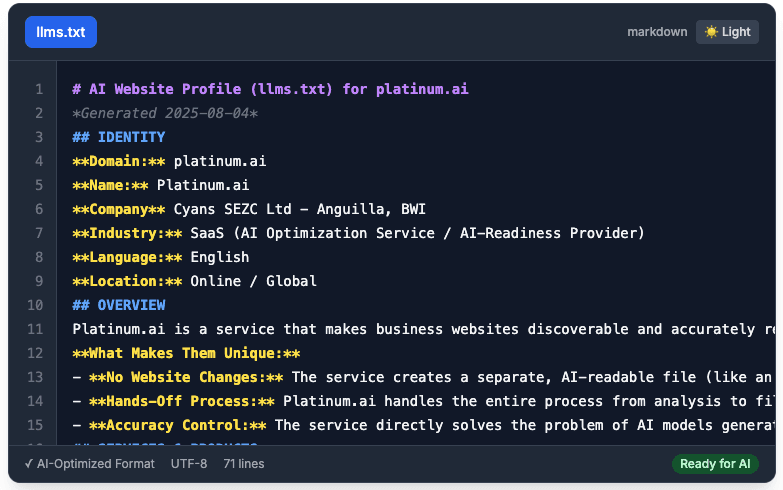
In a world of answer engines, simply being a link on a results page is no longer enough. Your business's information needs to be so clear, factual, and well-structured that an AI can confidently use it as a source for its answer. This is the core of AI Optimization (AIO). The businesses that provide clear, machine-readable facts via structured data will be the ones cited and recommended by these new engines.
Using a tool like Perplexity isn't just about improving your research workflow today. It's about getting a hands-on feel for the future of search. It helps you understand the kind of direct, factual information that AI is looking for, so you can better prepare your own website to provide it.