Key Takeaways
- Structured content improves discoverability
- Clear formatting helps readers and AI understand your content
- Quality content remains the foundation of effective communication
The Business Case for AI Optimization: Calculating the ROI of Being Discoverable
In the world of business, every investment demands a return. When you spend money on a new marketing campaign, a new piece of equipment, or a new employee, you expect that investment to generate more value than it costs. As businesses begin to grapple with the new discipline of AI Optimization (AIO)—the process of making your business discoverable by AI assistants and conversational search—a critical question arises: What is the ROI?
It's easy to see AIO, and the underlying work of implementing structured data, as a purely technical cost, another item on the web developer's to-do list. But this is a profound strategic error. AI Optimization is not a cost center; it is an investment in what is rapidly becoming one of the most important new customer acquisition channels. The ROI of AIO is not just about technical compliance; it's about the new customers you will attract and the leads you will no longer lose.
But how do you quantify that? How do you build a convincing business case for investing time and resources into making your website machine-readable? This guide will walk you through the process of calculating the potential ROI of AIO, helping you frame it not as an expense, but as a high-growth investment in the future of your business.
The Core Concept: Closing the Information Asymmetry Gap
In economics, 'informational asymmetry' is a situation where one party in a transaction has more or better information than the other. This perfectly describes the current relationship between your business and an AI assistant.
- You have perfect information about your business: your exact hours, your full range of services, your real-time availability.
- The AI Assistant has highly imperfect information. It's trying to guess the facts about your business by scraping your human-readable website and a dozen other, often-outdated, third-party sources.
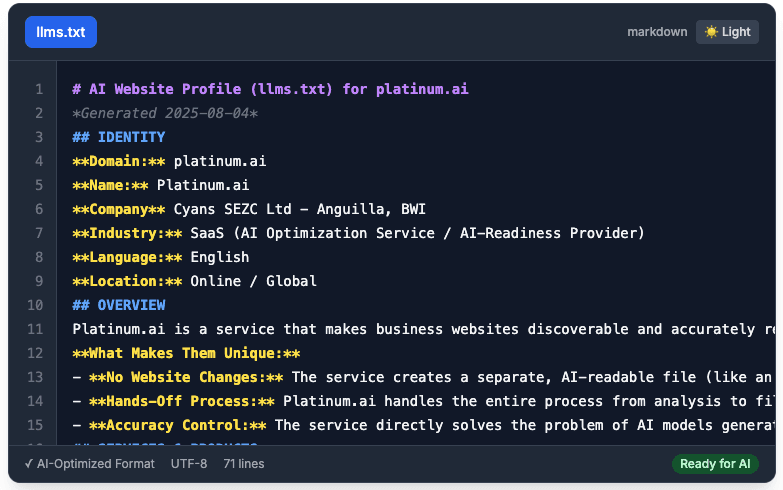
AI Optimization is the process of closing this information gap. By creating a definitive, machine-readable structured data file, you are giving the AI perfect information. The ROI comes from the economic advantage you gain by being a source of certainty in a world of digital uncertainty.
Calculating the ROI of AIO: A Step-by-Step Model
To calculate the potential ROI, we need to estimate the value of the opportunities you are currently losing and the new opportunities you will gain.
Step 1: Calculate the Cost of a Missed Lead
First, let's quantify the value of a single lead. This is a standard business calculation.
- Calculate Your Customer Lifetime Value (LTV): How much gross profit does an average customer generate for your business over their entire relationship with you? (e.g., $2,000).
- Calculate Your Lead-to-Close Rate: What percentage of your qualified leads becomes a paying customer? (e.g., 20%).
- Calculate the Value of a Qualified Lead (VQL):
LTV * Lead-to-Close Rate- Example:
$2,000 * 0.20 = $400. Every qualified lead that you fail to capture represents a $400 loss in potential value.
- Example:
Step 2: Estimate Your Current 'AI Invisibility' Rate
This is an estimate, but you can make an educated one. How many potential customers are now using voice search and AI assistants to find businesses like yours? While numbers vary by industry, conservative estimates suggest that 10-20% of search queries are now conversational, and this is growing rapidly.
- Estimate your monthly search volume: How many relevant search queries for your services happen in your area each month? (You can get this data from SEO tools).
- Estimate the AI query volume:
Monthly Search Volume * 15% - Estimate your 'failure rate': Based on your own 3-step AI discoverability test, what percentage of relevant, indirect queries do you fail to show up for? (Let's be conservative and say 80%).
Calculate Your Estimated Lost Leads Per Month:
AI Query Volume * Failure Rate
- Example: Imagine there are 1,000 monthly searches for your services.
- AI Query Volume:
1,000 * 0.15 = 150queries per month. - Estimated Lost Leads:
150 * 0.80 = 120queries where your business was a potential answer but was not recommended.
- AI Query Volume:
Step 3: Calculate the Potential Monthly Revenue Gain
Now, let's connect the dots. We're not assuming you'll win every single one of those lost leads. Let's assume that by becoming fully AI-optimized, you could capture just 10% of those queries you were previously invisible for.
Calculate Your New Leads Per Month from AIO:
Estimated Lost Leads * Capture Rate (10%)
- Example:
120 * 0.10 = 12new qualified leads per month.
Calculate Your Potential Monthly Revenue Gain:
New Leads Per Month * Value of a Qualified Lead (from Step 1)
- Example:
12 * $400 = $4,800in new potential gross profit per month.
Step 4: Calculate the Final ROI
Now you can make a clear, data-driven business case.
- The Gain: In our example, the potential gain is $4,800 per month.
- The Investment: What is the cost of implementing the AIO solution? This could be the one-time cost of a developer to add structured data or the monthly fee for a service like Platinum.ai. Let's say the investment is a one-time fee of $2,400.
The ROI Calculation:
- Payback Period:
$2,400 (Investment) / $4,800 (Monthly Gain) = 0.5$ months. The investment would pay for itself in just two weeks. - Annual ROI:
($4,800 * 12) - $2,400 = $55,200in new potential value in the first year alone.
Beyond the Numbers: The Intangible ROI
While this financial model is powerful, the business case for AIO also includes significant intangible benefits:
- Brand Authority and Trust: Being the business that an AI confidently recommends positions you as the authoritative leader in your category. This builds immense brand trust.
- Future-Proofing: You are preparing your business for a future where conversational AI is the dominant mode of search. Your competitors who fail to adapt will be playing catch-up for years.
- Improved Traditional SEO: The process of implementing structured data also has a direct, positive impact on your traditional SEO, often leading to 'rich snippets' in search results that increase your click-through rate.
Building the business case for AI Optimization requires a shift in perspective. You must stop seeing it as a technical cost and start seeing it for what it is: a direct investment in a new, powerful, and rapidly growing customer acquisition channel. By modeling the potential returns, you can make a clear, confident, and data-driven decision to invest in the future visibility of your business.